
by : Lutfiah Nur Rohmah Salaamah
Editor : Muhaji Sahnita Putri
Translator : Aisyah Nurdiva Dewary Priatna
Monday, February 12th 2024
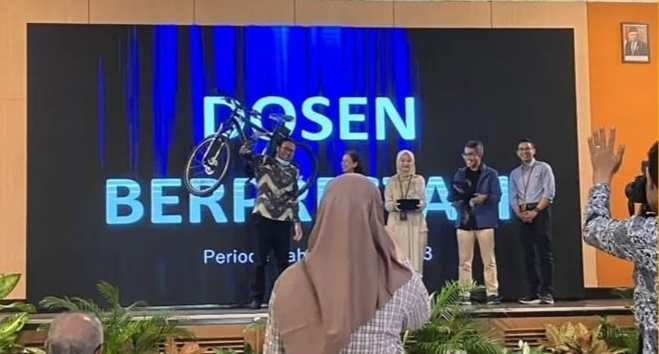
BANDUNG, meteo.itb.ac.id — Dr. Rusmawan Suwarman, S.Si., M.T. an accomplished meteorology lecturer at the Faculty of Earth Sciences and Technology (FITB) ITB—recognized during the faculty’s 16th-anniversary celebration—has conducted significant research in his field. Dr. Rusmawan believes that every research project plays a vital role in advancing the science of meteorology. His research covers diverse topics such as regional hydrometeorology, regional or synoptic-scale hydrometeorological dynamics, climate change, and the hydrometeorological disasters frequently occurring in Indonesia.
Dr. Rusmawan Suwarman has conducted several important studies focusing on his area of expertise: hydrometeorological isotopes. This work examines the origins of rainfall sources across the Indonesian Maritime Continent. His research has contributed significantly to the understanding of variability and anomalies within hydrometeorological dynamic systems and climate change. The Variability of Stable Isotopes and Water Origin of Precipitation Over the Maritime Continent (2013) and Characteristics of Seasonal Precipitation Isotope Variability in Indonesia (2017) are two examples of his research on this subject. Additionally, Dr. Rusmawan has been involved in research regarding hydrometeorological disasters, including urban flooding; one such example is Flood Modeling and Baseline Study in Urban and High Population Environment: A Case Study of Majalaya, Indonesia (as a co-author). He has also been involved in other research related to hydrometeorological disasters, such as studies on the impact of the El Niño-Southern Oscillation (ENSO)—specifically a 2017 paper titled “El Niño Southern Oscillation Signature in Atmospheric Water Isotopes over Maritime Continent during Wet Season”—as well as research on air pollution variability (a 2021 study titled “Variability of PM10 in a Global Atmosphere Watch Station Near the Equator”) and the use of satellites to estimate evaporation (a 2018 study titled “Application of Satellites in Estimating Evaporation in Reservoir Areas,” focusing on the Saguling Reservoir in West Java). These studies contribute to a better understanding of the natural dynamics affecting water resources, climate change, and overall environmental impacts. Collaboration with various parties, including fellow researchers, has been key to the success of this impactful research.
It is important to note that success in this research was not achieved in isolation. Dr. Rusmawan places great emphasis on the importance of collaboration and camaraderie within the research community. He notes that his recognition as an outstanding lecturer is not merely a personal honor but a shared achievement. Much of his research involved collaboration with colleagues—including those from other study programs—which added significant value to the work. Regarding time management between teaching, research, and other activities, Dr. Rusmawan explains that maintaining physical health through exercise is a priority.
When asked for advice for students interested in pursuing a research career, Dr. Rusmawan replied, “Career paths do not always align with our initial plans. I originally aspired to be an artist, yet life’s journey led me to the world of research, and I enjoy it.” He also reminds students of the importance of finding passion in their research and remaining both confident and humble throughout the process. Sometimes, opportunities arise unexpectedly, and it is important to remain open to them.
Regarding future research, Dr. Rusmawan has several plans to continue
exploring the field of meteorology. “There is still much to explore
in meteorology. One area involves gaining a better understanding of
climate phenomena in West Java and identifying the diverse climate
systems within the region,” he stated. He will also continue to mentor
students in their research, helping them understand the physical
properties and natural dynamics that influence climate change and
water resources. Looking toward the future of his research,
Dr. Rusmawan views prediction as the cornerstone of meteorological
knowledge. Improving the accuracy of weather and climate forecasting
will remain a primary research focus. Such accuracy will facilitate
better planning and decision-making in the face of climate change
and natural disasters.
Finally, Dr. Rusmawan wishes to convey a message to students and young
researchers regarding the importance of logic and structured understanding
in research. He emphasizes that logic and a solid understanding serve as
foundations for success across various sectors of life. Furthermore, he
reminds us that wisdom and intelligence are not merely about being smart,
but also about a deeper understanding of the world, knowledge, experience, and ethics. The spirit of enlightening the nation must remain the primary goal.