
By : Mely Anggrini
Saturday, October 26th 2024

BANDUNG, meteo.itb.ac.id – The Meteorology Study Program at the Bandung Institute of Technology (ITB) conducted research on dynamic thermal comfort in Indonesia in collaboration with the Varquez Laboratory (Department of Transdisciplinary Science and Engineering, Tokyo Institute of Technology) on September 19–20, 2024.
The initiative comprised a series of events, ranging from research discussions and experiments to a special lecture. Carried out in partnership with ITB’s Analysis Laboratory and Applied Meteorology Laboratory, the activity aimed to improve thermal comfort indices by accounting for dynamic environments from the perspective of human movement.

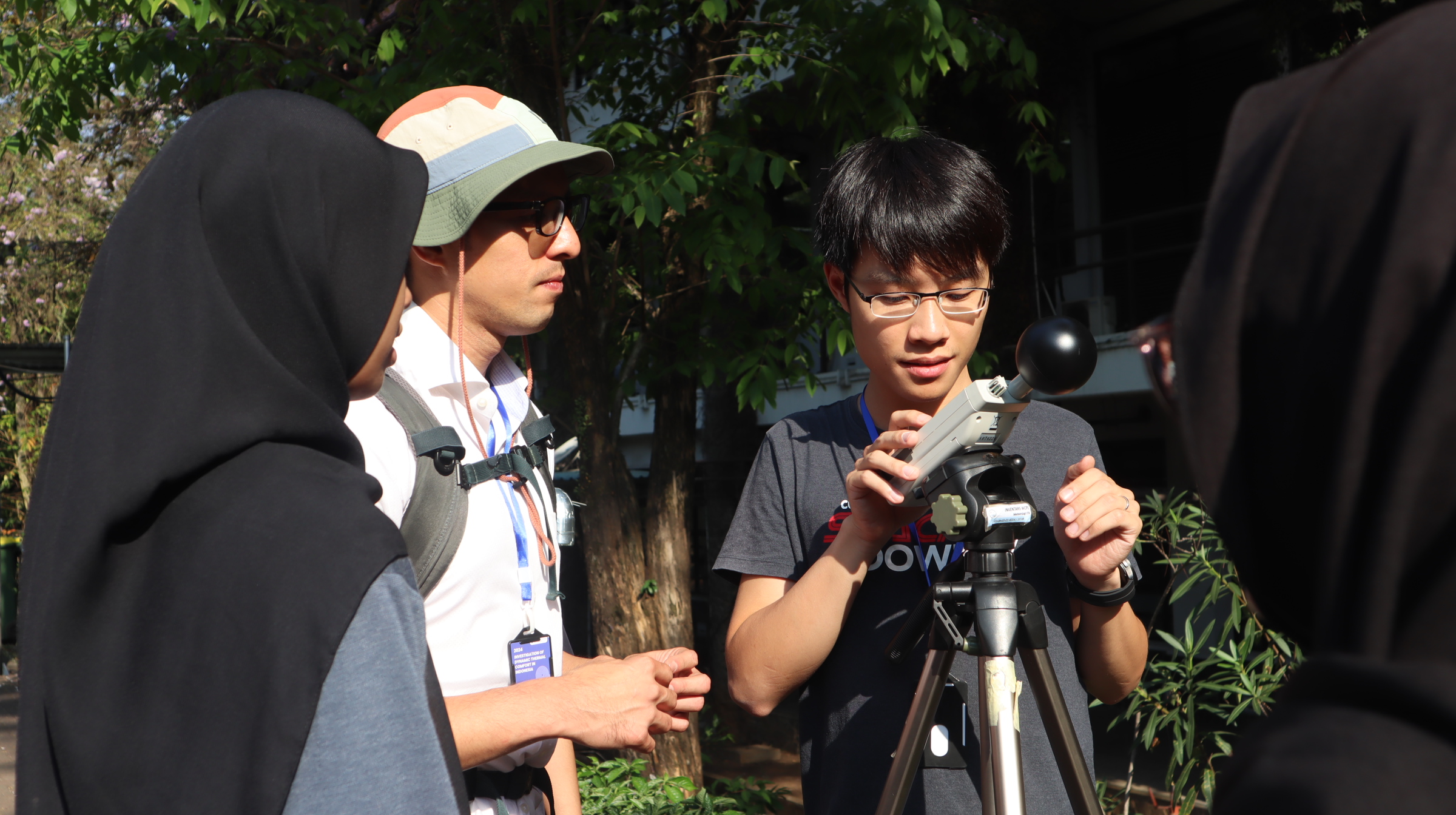
Special lectures were led by Dr. Alvin C. G. Varquez, focusing on urban climate, and Dr. Do Ngoc Khanh, focusing on urbanization and thermal comfort. Beyond the engaging presentations, the session also featured experiments conducted by Dr. Do Ngoc Khanh, Mr. Ryoga Hiroki, and Ms. Xiao Jin.
This research, titled “Enhancing Dynamic Thermal Comfort,” aimed to assess thermal comfort at the individual level. The experiments utilized two types of equipment: a jacket equipped with fans and thermal comfort sensors attached to various points on the body, including the legs, fingers, and arms.
“Before the equipment was attached, we were asked about the clothing and materials we were wearing. This was done to establish a baseline for each individual’s comfort level prior to the experiment,” said Windi, one of the participants.

Participants will engage in discussions about their sensations after experiencing two conditions: remaining stationary indoors and moving outdoors. This experiment offers participants a new perspective on individual thermal comfort.
“I was interested in participating in this experiment because it looked fun, and I was curious about the equipment being used. It turned out to be a really exciting experience,” said Serra.
Through this activity, students are expected to gain a better understanding of the thermal environment from the perspective of human comfort, helping to mitigate heat-related risks associated with climate change and urbanization.