By: Daffa Tsabat (Meteorology, 2023)

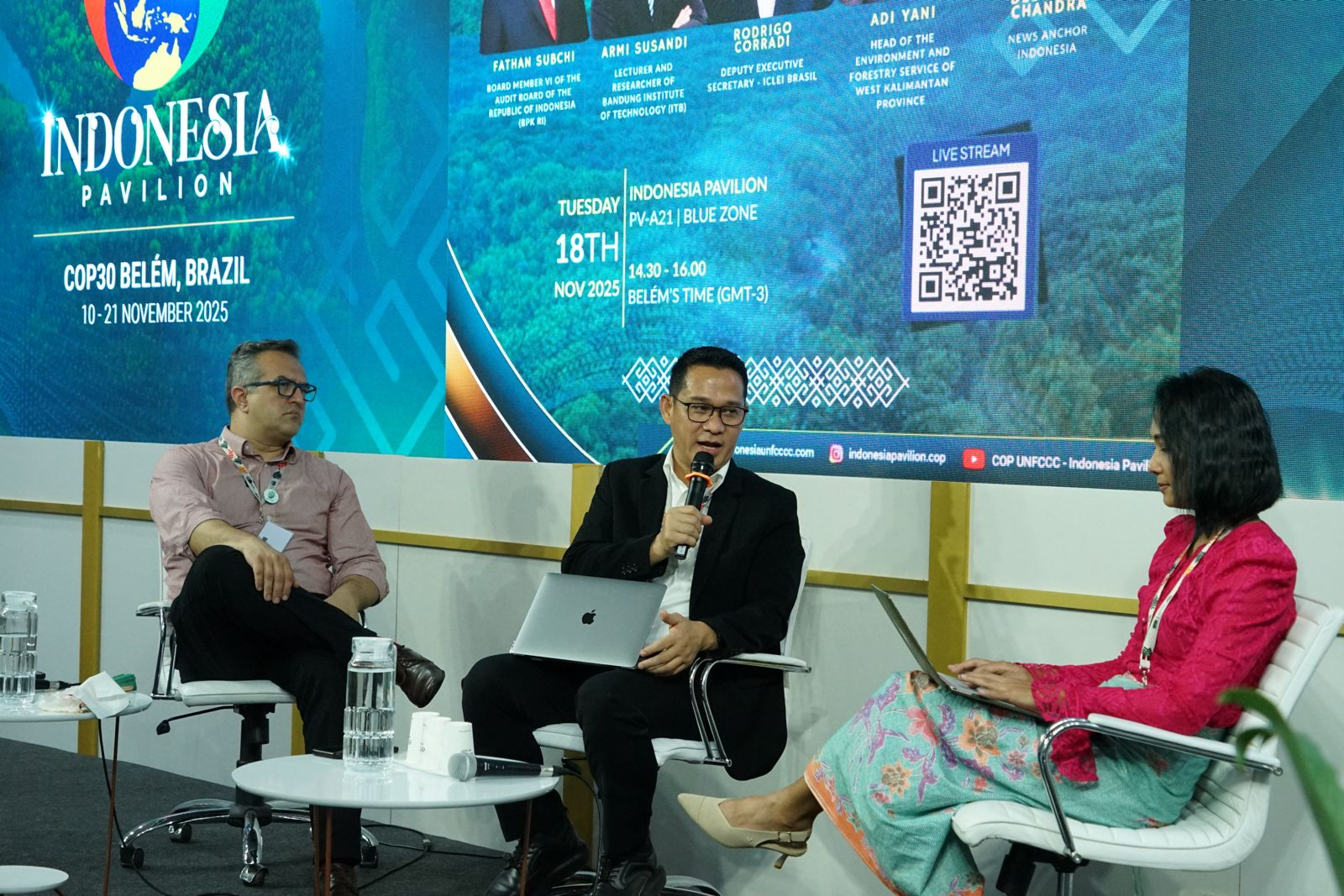
BRAZIL, meteo.itb.ac.id – The threat of forest and land fires (karhutla) in Indonesia has found an innovative answer on the world stage. During a dialogue session at the Indonesia Pavilion of the United Nations Climate Change Conference (COP30) in Belém, Brazil, on Tuesday (November 18, 2025), Dr.rer.nat. Armi Susandi, M.T., presented an advanced Digital Twin-based solution with the potential to shift the paradigm of forest fire management from reactive to proactive.
The platform is called FORMS (Forest Fire Management System), a breakthrough from Institut Teknologi Bandung (ITB) designed not only for national needs, but also adoptable on a global scale to address increasingly complex forest fire challenges arising from climate change.
“FORMS is a digital twin that replicates the dynamics of peatlands and forests in a digital environment. The platform integrates data assimilation, big data processing with supercomputing, and artificial intelligence to monitor, predict risks, and support rapid and accurate decision-making,” explained Dr. Armi in a session entitled “Uniting Forces: The Role of Government and Organization in Addressing Climate Issues.”
Dr. Armi Susandi is no stranger to Indonesia’s climate and environmental science community. A lecturer and researcher in ITB’s Meteorology Study Program, he has long been recognized as a visionary figure with a wealth of innovations in climatology, carbon policy, and environmental intelligence. His work has frequently served as an important reference at both national and international levels. Through FORMS, Armi once again affirms the vital role of science and technology in responding to real environmental challenges.
More Than Just Early Detection

FORMS, which is part of the RIMBA (Real-Time Integrated Monitoring for Burnt Alerts) Consortium, is designed as a holistic and end-to-end platform. It does not focus solely on early detection, but covers the entire fire management cycle, including prevention, preparedness, response, and recovery.
The key features of FORMS include:
- High-accuracy hotspot prediction
- Fire Danger Rating System (FDRS)
- High-resolution weather prediction
- Data assimilation from various satellites such as Terra/Aqua MODIS, Landsat, and Sentinel
What sets FORMS apart from other similar platforms is its ability to analyze fire vulnerability by incorporating anthropogenic factors (human activities). This is highly relevant to BNPB publications stating that 99% of forest fires in Indonesia are caused by human activity.
Implementation Readiness: Four Key Pillars

In his presentation, Dr. Armi emphasized that the success of FORMS depends on four key pillars for its implementation in Indonesia:
1. Comprehensive Data
Relying not only on satellite data, but also on ground truth data to improve model accuracy and early warning systems.
2. Competent Young Human Resources
Young Indonesian talent with expertise in information systems, data science, and meteorology is needed to develop and operate the platform.
3. Synergistic Coordination
Strong collaboration among BNPB, BPBD, KLHK, the Ministry of Forestry, regional governments, and the private sector is key to enabling FORMS to function optimally.
4. A Firm Legal Framework
A legal foundation is required so that FORMS and Digital Twin technology can be designated as the primary tools in combating and preventing forest and land fires.
By presenting FORMS at an international forum, Dr. Armi Susandi not only elevated Indonesia’s reputation on the global stage, but also reinforced the contribution of Indonesian science and technology in addressing the challenges of climate change. This innovation stands as a concrete example of how Digital Twin technology can protect ecosystems, safeguard public health, and support global climate stability