
By: BSO Zephyrus 2025 Content Strategist Team
Editor: Mely Anggrini (Meteorology, 2022)

BANDUNG, meteo.itb.ac.id – Throughout the 2025 management period, BSO Zephyrus actively built bridges between technology, meteorological literacy, and community empowerment. Various environmental instruments were installed, training sessions were held, and educational programs in schools and communities were progressively carried out. These efforts not only produced technical achievements, but also strengthened a collaborative network that serves as the foundation for program sustainability in the years ahead.
The following are the key milestones that marked Zephyrus’s journey throughout 2025.
1. Strengthening the Z-ONA Network: Three Active Points and One Development Poin

In 2025, Zephyrus concentrated its programs on strengthening Z-ONA (Zephyrus–Observasi Nadir Air / Zephyrus–Water Level Observation) as the foundation of a data-driven flood monitoring system. This effort began with site mapping and surveys to identify the most relevant locations for instrument placement. The survey results pointed to three river sectors representing inflow discharge routes: Ciharus (downstream), Cibangoak (midstream), and Sanding–Paseh (upstream). All three points are now active and operational, equipped with AWLR–ARR sensors, ESP32 microcontrollers, and solar panel systems — all connected to real-time telemetry that transmits data every five minutes to zephyrusitb.com.
In addition to the three operational points, Zephyrus also established one development point in the upstream sector to fill a spatial data gap. As a result, the focus of infrastructure development no longer stops at equipment installation, but extends to forming a multi-node monitoring network that serves as the basis for collaborative flood data management with disaster-response communities in the Majalaya area.
2. Z-INSPACT: Communities Assemble Their Own Flood Monitoring Instrument
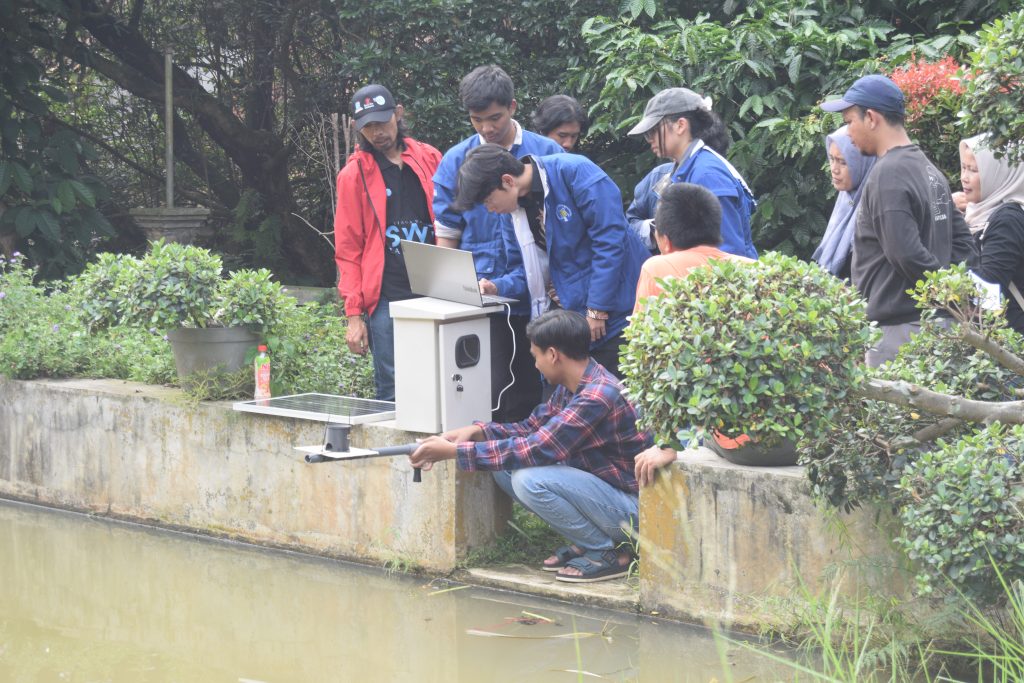
The transfer of technology to communities is a critical component in ensuring the system can operate independently. Through Z-INSPACT, held at the end of May 2025, Zephyrus organized a hydrometeorological instrument assembly training for 16 participants from various disaster-response communities in the Majalaya area and its surroundings. Participants were introduced to the instrument structure, ultrasonic sensor operating procedures, electrical circuit assembly, and calibration practices using water discharge simulations.
The entire process was complemented by the “Z-ONA Pocket Guide” as a technical field reference. Through a learning-by-doing approach, participants not only understood how the equipment works, but also acquired the basic skills to maintain and operate the instruments independently. This initiative ensures that Z-ONA does not remain merely an “aid tool,” but becomes an appropriate technology capable of being managed by the community itself.
3. Z-INSPACT Goes to School: Weather Literacy and the Regeneration of Local Champions

Weather literacy was strengthened through Z-INSPACT Goes to School, held from September to October 2025, involving 63 students from 10 schools in the Majalaya area. This educational program was structured in a classroom rotation format covering the basics of meteorology, hands-on weather observation using an Automatic Weather Station (AWS), and discussions on hydrometeorological phenomena relevant to the local environment. This approach gave students the opportunity to understand weather not merely as a theory, but as a phenomenon that can be observed and analyzed through data.
In follow-up sessions, participants were introduced to the Z-ONA instrument to see how discharge and rainfall data are recorded, and how such data can be used as a basis for decision-making when there is a potential flood risk. Students were also guided to practice reading water level and daily rainfall graphs, recognize patterns that indicate standby conditions, and discuss actions that communities can take under certain risk scenarios. Through this process, Z-INSPACT Goes to School opened access to applied meteorological understanding and prepared a new generation of local champions who have the potential to play a role in future flood monitoring efforts.
4. System Maintenance Series: 8 Rounds of Upkeep for Data Stability

The sustainability of a monitoring system cannot be achieved without maintenance. Over the course of one management period, Zephyrus conducted eight rounds of maintenance on the Z-ONA network to ensure the equipment remained stably operational ahead of the peak rainy season. Maintenance activities included cleaning solar panels to maintain power efficiency, checking ultrasonic sensors, readjusting instrument mounts to ensure accurate water level readings, replacing batteries and ESP32 microcontrollers to improve real-time data transmission, and relocating sensors when the surrounding environment underwent physical changes. This series of maintenance ensured that Z-ONA did not remain a mere installation project, but evolved into a living and reliable operational asset.
5. R&D of Z-MORE & Website: Toward an Integrated Information System

In addition to field activities, Zephyrus developed supporting systems to strengthen data integration. Z-MORE (Zephyrus–Model of Rainfall Effect) was developed as a simplified approach to reading the relationship between rainfall input and potential discharge increases, as an initial step toward integrating a WRF-Hydro-based hydrological model. In parallel, zephyrusitb.com was updated as an internal data center containing real-time data, technical documentation, and activity updates. This development paves the way toward an integrated information system accessible to the public as a flood mitigation dashboard in subsequent program phases.
6. Z-SHARE: Final Dissemination and a Stage for Collaboration

The closing of the 2025 management period program was held in November 2025 through Z-SHARE: Final Project, a dissemination forum organized at SMA Negeri 2 Majalaya attended by 29 participants, ranging from students to local disaster-response communities. The event featured presentations on key achievements such as the installation of Z-ONA, the results of the instrument assembly training, and the initial progress of data-driven discharge prediction model development. Beyond the presentation sessions, participants joined a technology demonstration and a dialogue on plans for instrument management after student mentorship concludes. Through Z-SHARE, the program was closed with a summary of results and reflections on lessons learned, while also aligning expectations regarding the direction of sustainability for the monitoring system built throughout the year.
From classrooms to riverbanks, from presentation sessions to technical fieldwork, this series of experiences serves as a reminder that the impact of community service does not always come in the form of large-scale installations or broad programs. Impact is also reflected in the continuity of relationships, the enhancement of community capacity, and the preservation of spaces for dialogue. This process demonstrates that sustainability is not only about delivering technology, but about ensuring that technology can be understood, maintained, and utilized in accordance with continuously evolving needs.

Building on this journey, Zephyrus reaffirms its commitment to continuing its community service efforts through an approach that is adaptive, collaborative, and grounded in community needs. The achievements that have been realized serve as a foundation for addressing shortcomings, refining the system, and sharpening the program’s direction in the next period. With the foundation that has been built, Zephyrus is ready to step into the next phase with the same spirit: delivering knowledge that is relevant, integrated, and of genuine benefit to the environment and the communities it serves